Tuesday, December 10, 2013

The NSA Goes Rogue

Propublica--World of Spycraft
NSA and CIA operatives have determined that online role-playing games are opportune platforms on which to conduct terrorist acts or plots. Intelligence agencies have determined with some revelation that online games are becoming more and more prominent, and due to the anonymous nature of such games, and the ways that violence already pervade in them and their culture, video games are ideal for creating terrorist plots. With agents in these online worlds searching for seeds of terrorism or domestic/international threats, (or perhaps just getting their Death Knights to level 90) can we maintain our sense of privacy? Internet culture with respect to gaming often features brutal and violent personalities, for the veil of the computer screen and miles of distance make it easy to antagonize people--you likely won't feel any repercussions. Still, there are some who play to entertain themselves or meet other like-minded individuals. While many speak on the internet without carefully considering their words, and likely don't care how they offend others, they may find the federal government knocking at their doors. What may be intended as a tasteless joke in a competitive gaming scenario may be misinterpreted as a threat to national security.
While the government probably will not misinterpret "im gonna kill u" said by sk8rboi420 to be a glimpse into the psyche of a rampant murderer, the frequency at which violence is discussed in video games today makes it nearly impossible to distinguish what is real and what is a waste of time. Are NSA agents looking to lounge around and play World of Warcraft while collecting their paychecks? Or are there really Dwarven Engineers who may be engineering plots against the government? Regardless of whether or not the national government uncovers terrorism in the World of Warcraft, they have drawn some ground-breaking conclusions such as "players under age 18 often used all capital letters both in chat messages and in their avatar names."
Author: Andrew W. Lehren

CNN--Snowden Condemns NSA
Snowden attacks the NSA’s actions as offensive and shocking. In a letter to a German magazine, Snowden vividly describes how objections to government surveillance, which prompted many other national governments to conduct their own investigations.
Author: Chelsea J. Carter & Susanna Capelouto

Washington Post--NSA Intelligence Gathering
Washington Post puts the magnitude of the surveillance into perspective by claiming that the NSA gains billions of phone records every day with information on the whereabouts of phones and mobile devices. NSA agents attempt to hide the sheer number of documents collected, as well as other figures.
Author: Julie Tate

Wednesday, December 4, 2013

Catching Liars

Who wants to be a millionaire? I'd think nearly everyone, save Buddhists, minimalists, and billionaires. The question is, what price are we willing to pay to get there? Some get caught up in the rat race, some steal and ransack, but most never quite make it to that 6th zero. Charles Ingram was desperate as any to make a bit of money, and when he was called up as a contestant on Who Wants to be a Millionaire? he saw his opportunity. Charles Ingram is by no means incompetent. He's clearly experienced in playing the system, as he develops a system with one Tecwen Whittock, another contestant, to cheat on the show and win the million dollars. He's quickly found out, however, as his system is almost comical to behold.
Here's the first part right at your fingertips. Should you decide you're interested, the rest are linked below.
Still, both Tecwen Whittock and Charles Ingram remind us of a societal flaw that seems to pervade more and more with time. Cheaters seem to prosper. In their case, they were discovered, but in countless insurance fraud instances across the nation every year, people are able to get away with murder, nobody the wiser (in fact, over 30% of murders in the U.S. went unsolved in 2012). Charles Ingram didn't seem to be heard from much afterwards, but did receive some sort of comeuppance referenced at the end of the documentary. Still, justice didn't seem to be the focus of this documentary. It only seemed to further the point that, if done correctly, cheating can be highly beneficial. Others may learn from his mistakes and, as time goes on, there's no telling how cheating might involve, for just as the technology to prevent it advances, the same advancements can be used to break it.
Do cheaters receive more than just a slap on the wrist? More often than not, yes. But they must be caught first, and in that condition lies a great failure of our system--we either ignore cheating when it occurs right before our eyes, or are unable to recognize it before it escalates.

Monday, December 2, 2013

A Quick Way to Become a Social Outcast

There's nothing more frustrating than someone arguing irrefutably incorrect information. Strike that, there's nothing more frustrating than someone arguing irrefutably incorrect information without realizing it's incorrect. That's the case for me, at least. With the possible exception of being condescended, it's my number one pet peeve, and it happened at Chamber Retreat. Each section was required to present a game to play--a way to unwind after hours of singing. One such game was the classic outdoors sensation known as camouflage. For those of you who aren't familiar, the rules can be found here:
The purpose of camouflage is simple--be camouflaged. That entails being able to see someone without them seeing you. So when the game is explained where it's very easy to sit out of sight and have a distinct advantage over the person in the center, it becomes something entirely different--the infamous Waiting Game (hardly a game if you ask me.) Now upon explanation of "camouflage," to clarify, I attempted to suggest the simple correction to the game that would transform it back into what it was intended to be. We had it set up to where, if you read the rules, rather than hold up a finger to ensure vision was maintained throughout the process of calling people out, the central scouter simply shouted out colors. This completely eliminates the purpose of the game, and when Sheryl Warfield, bless her heart because she can't stand the same things I can't, and I opened our mouths, we were met with exasperated sighs and demonization.
Boom. Instant pariahs.
Granted, the presenter may have felt disrespected, because as he was taught to play the game, it made sense to him, but it was simply incorrect. Looking around, I made eye contact with plenty of people whom I knew had experience playing the game correctly, and they confirmed that I wasn't crazy, but they simply kept their mouths shut. I thought them wiser than I. They foresaw the inevitable consequence of everyone's disdain and scorn. I was impetuous, and for whatever reason, I felt as though I was some sort of crusader against the injustice of a game. Well, Sir Jeffrey the Impetuous, that was a dumb way to look at it. I wasn't "saving" anything, and rather than attempt to enjoy the Waiting Game, I let the flaws burden on me and even got into a verbal fight with the presenter, a good friend of mine. Sure, we're fine now because it was too trivial to get in the way of a good friendship, but there was simply no purpose.
So why do people keep their mouths shut? Why don't people complain when the train reaches 85 degrees or they don't like the music in Abercrombie and Fitch? Because it's just. not. worth it. It isn't worth the disapproval and the dirty looks. It isn't worth starting an argument over something so trivial, and most of all, whether people agree with you or not, you're likely not going to receive much support. We are condemned to silence, and in that silence, we build character.
Character Building

Thursday, November 14, 2013

The Norms of Mistrust

Regarding trust, we all perceive it differently. There are the gullible ones, who tend to be optimists, the cynical ones, usually pessimists, and everything in between. We all have varying levels of trust for those around us, however everyone eventually learns that there is no common denominator to play to--the extremes are all we can prepare for. We immunize ourselves with mistrust, such that the neurologically impaired or the simply destructive people in society who thrive on anarchy don't have more opportunities than they need to victimize us. Furthermore, in warding off the perils of day-to-day life, we gain a sense of security, but lose the sense of community so many strive to reclaim. What we fail to recognize is that the issue stems from an inability to trust, or that perhaps this inability to trust is not necessarily a failure of society. There are small victories and great pitfalls of our mistrusting culture.

Let us examine locks on our doors. Indeed, they serve a purpose, as most of us don't want a burglar, murderer, or worse wandering into our midst while relaxing and watching Grey's Anatomy. We use locks to feel safe and protected, so that we don't need to have a vigilant watch at all times. Then, why do we need locks on our doors inside the house? Some like to protect their privacy when we change or yada yada,
but to a certain extent, what is the purpose of the indoor lock? It isn't a mistrust of our family members. It's partially a protective measure--not physical but privacy-based. This boils down to social norms. To not have locks on your doors is to be a heathen, a crazy person. To not have locks on your front doors is unthinkable.

Social norms dictate much of what we do, and it isn't all necessarily rational, as we observed in the essays regarding obligatory small-talk and the ways we communicate. Trust is one of these institutions. Schools are required to send home permission slips for field trips, or for watching rated PG movies in elementary school. Most classes, however, scoff at the notion that a parent is going to morally object to a trip to Connoly Ranch or a viewing of Shrek 2. Obviously, school systems are preparing for every contingency--those instances when there is a parent who takes up a complaint and decides to sue the district for all it's worth--but when surveying the class to get an estimate on how many of their parents would be O.K. with Shrek, we ignore their responses and send home permission slips regardless. The word of a child can never be trusted.

The government is responsible for 9/11. Actually, aliens are. Or wait, just Obama. It was his master plan all along, and he's a reptilian space creature bent on the destruction of the human race. No. Just, no. Americans, especially, romanticize mystery and intrigue. That's why tabloids are so popular, and why scandals take down political figures almost daily it seems. Still, conspiracies pervade in our culture, and the most critical piece of them--mistrust for the government. We aren't capable of placing our faith in those protecting us, possibly for good reason, as they constantly lie, (a social norm for politicians) but to an extent that surpasses absurdity. And we satirize it, don't we? We mock the conspiracy theorists, though they're more numerous than you'd believe. We don't trust them, they don't trust us, or science always. Is this to protect ourselves? Maybe against appearing foolish, but not from any sort of real danger. We mock them and don't listen to their warnings because A) they're preposterous mostly, and B) it's commonplace not to.

Wednesday, October 30, 2013

Stacking Paper

Insider trading--colluding with sources who hold crucial information about coming trends in the stock market or in sound investments in order to reap massive reward with less risk--has been the bane of many public figures. Hedge fund managers from SAC in 2013 and Rajat Gupta have felt the effects of getting caught with their pants around their ankles. More notably, Hillary Rodham Clinton was accused of tangling with the same legal grey area. With the help of James Blair, a Tyson Foods Company lawyer, she was able to "[net] $100,000 through trading." While this doesn't entail much blatant lying, this is considered dishonest by most everyone informed enough to understand the complexity of such dealings. This is a very unique brand of lie--one that Ericsson didn't seem to touch on. This is collusion and distortion. Hillary Clinton hid behind a curtain of illegality and likely delusion, one that Ericsson was able to aptly explain. While it's generally accepted that Clinton dealt with insider trading, she received no more than a slap on the wrist, as official charges were never brought on, demonstrating the ease of which lies are committed when backed by cold hard cash. Clinton may have victimized the stock market or competitors, but they remained faceless, whereas Bernie Madoff had a profound impact on many American lives, thus, he was made into a pariah and a criminal (I'm not saying he wasn't a criminal by any means) on a grander scale. To return to the matter at hand, however, it appears that lying, while it is a global occurrence that may forever be unavoidable, yields far different results depending on the nature of the lie and the perpetrator's status. Hillary Clinton is a beloved political figure in many households of the United States, (and a not-so-beloved figure in others) so naturally, she had a support group behind her, defending her actions. Clinton supporters seemed to deny the accusations--guilty of lies themselves. Denial, delusion--whatever you label it as, it's a rejection of the truth. The same way conspiracy theorists formulate ridiculous notions that the government caused 9/11, Obama is a space reptile using mind control on the American people, or that the lovable Disney classic Aladdin is set in a post-apocalyptic future, many Americans were content to believe Clinton never committed insider trading. Due to Clinton's already strong reputation among many Americans, it appears it was easier for her to conceal and justify her actions and deflect accusations that appeared to be true.

Tuesday, October 29, 2013

Men Are From Earth, Women Are Also From Earth

The Playbook (How I Met Your Mother reference--written by Barney Stinson)

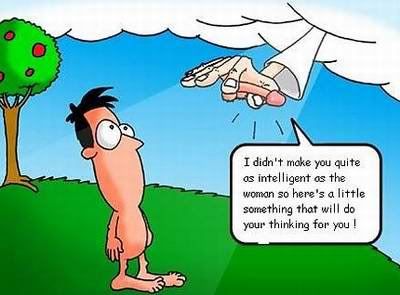
Men are reckless and stupid--they default to their "lower" brain more often than not. At least, that's what this image would have you believe. In this creationist rendition of intellectual inequality, men are painted as savage--hence the nudity and primal nature of the cartoon (yes, I understand Adam and Eve wouldn't have clothes, but the setting and time frame are rather deliberate).

The first line sums it up--then it's expanded on beneath. The advertisement, while extremely dated, represents a facet of misogyny that views women as feeble, physically incapable, or even a detriment to men as a population. The woman is faceless and anonymous, as she attempts to pull herself up with the help of the careless yet confident men. Undoubtedly, the advertisers have taken many different steps in establishing her as symbolic of all women, and establishing women, by a general rule of thumb, as "beneath men." Such an ad seems to claim that men are required to be strong, athletic, outdoorsy, and assertive, while women exist to please the man when he returns from his excursions, hence the line, "Indoors, women are useful--even pleasant."

Evidently, these are the two easiest and most effective ways of being a "good wife." If this doesn't force an idea of patriarchy and a woman's role in it down your throat, then I'm not sure what does. There's no insight I have on such an image--it's worth a thousand on its own... or maybe just the two--sex and sandwich. All this says is that women need to provide for men in the home, and satisfy their every whim. Complete that with an overtly sexual picture of a blond bent over, and you've got a tornado of matriarchy headed your way.

The roles of men and women are concepts that biologists and historians attempt to definitively outline, but the dynamic of every relationship and the independence and strengths of each individual make it impossible to do so. From what the images depict, and what T.V. shows such as I Love Lucy and Leave it to Beaver say, dated though they are, women are "supposed" to stay home, cook, clean, and please their husbands sexually without a fuss or reluctance. Men, on the other hand, are "supposed" to be strong, command authority, provide financial stability, and guide women. Obviously social consciousness has evolved a great deal since the days of Lucille Ball, but there are still many competing schools of thought. Feminism as a school doesn't believe that men are stupid, but there is certainly some fervent opposition to patriarchy in the form of backlashing (women who claim men are stupid and need women to keep them from doing dangerous or reckless things). Modern feminism seeks only equality, and to draw attention to the double standards of gender stereotypes--the same aim of I Want a Wife.

Thursday, October 10, 2013

Now Who Would Dwell In Hell?

Hell in the physical does not weigh on me. I view the Bible through a critical lens. I see the merit in many of the teachings--family values and an appreciation for the wise--but the aspect of fear as a motivation to help others, and the belief that helping others is somehow more virtuous than helping ourselves, these are not teachings I adhere to or respect in the slightest. I'm not one of the atheists who approaches you, telling you you're stupid and misguided for believing in God, but I'm not one to remain silent while others thrust their beliefs in my face. I have a difficult time believing in the afterlife and in an almighty power that controls everything and everyone by a strict moral code. Perfection is abstract, and it seems impossible to me to have a figurative God without flaws. Perfection is a personal standard, because with all of the conflicting beliefs and opinions that people can possibly have, how would God possibly rate one value over another? In any case, it's impossible to deny the merits of religion. My great aunt, at one point in her life, faced drug addiction and troublesome behavior, but turned to God as a vessel of strength, and she found the strength inside of herself to overcome it. We welcomed her back into our lives and she was nothing but the most kind-hearted, altruistic and content woman I had met. Later, she faced a terminal brain cancer--this was a few years ago--and rather than fear death she simply had the most beautiful glimmer in her eyes. She was ready to go, because she had achieved personal satisfaction through religion. Religion may not be for me, but for plenty of individuals, they use it to gain strength and hope in a lost place. That aspect is often overshadowed in my mind by the hate and trivial destruction incurred by religious zealousness or differences. I'm content to allow a mutual respect and indifference--that is, if you want to worship Bielzebub and drink your own blood, that's your M.O. If I don't want to, I shouldn't have to either. The same goes for lifestyle choices in general, and that's where topics such as homosexuality and abortion enter the picture of religion. Churches should not be spreading hate and contempt for people based on choices that don't influence them, coughWESTBOROcough... For those of you who weren't aware of the Westboro Baptist Church's dealings, you are likely shocked and appalled. The hate that they spout has created, truly, a miniature hell on earth for the families and loved ones of many homosexual soldiers, and homosexuals themselves. Hell can be viewed through many different lenses. Whereas one might die of fear should they be slowly submerged into a fish-tank filled with sharks, others simply chuckle--until you mention their deep-seeded abandonment issues. Everyone has different quirks and buttons to be pushed, but it's important to me to remember that no matter what "Hell on Earth" one might concoct mentally, there's always a way to make it worse. A rainy day could quickly turn into a rainy week, and a brutal stabbing could turn into something unmentionable. While we can always, in the dark corners of our conscious, picture a worse scenario, there's simply no purpose. To be asked to describe the worst possible feeling or situation to place myself in is not only impossible, but pointless as well. I choose to not dwell on my insecurities or the ways I could be tortured. I'm not an optimist, but I am a realist, and a realist doesn't waste much time in the hypothetical.

For those of you reading simply to hear about a fear or an insecurity or anything else of that nature--those of you who wish to dig up dirt--I suppose being an only child would be pretty awful. If something were to happen to my brothers, I would be devastated, naturally, but the loneliness resulting from being an only child would be something I couldn't handle. I am mostly introverted, it might surprise most people to read, because I don't display that quality during class at all, but in reality, I'm fairly antisocial.