Wednesday, October 30, 2013
Stacking Paper
Insider trading--colluding with sources who hold crucial information about coming trends in the stock market or in sound investments in order to reap massive reward with less risk--has been the bane of many public figures. Hedge fund managers from SAC in 2013 and Rajat Gupta have felt the effects of getting caught with their pants around their ankles. More notably, Hillary Rodham Clinton was accused of tangling with the same legal grey area. With the help of James Blair, a Tyson Foods Company lawyer, she was able to "[net] $100,000 through trading." While this doesn't entail much blatant lying, this is considered dishonest by most everyone informed enough to understand the complexity of such dealings. This is a very unique brand of lie--one that Ericsson didn't seem to touch on. This is collusion and distortion. Hillary Clinton hid behind a curtain of illegality and likely delusion, one that Ericsson was able to aptly explain. While it's generally accepted that Clinton dealt with insider trading, she received no more than a slap on the wrist, as official charges were never brought on, demonstrating the ease of which lies are committed when backed by cold hard cash. Clinton may have victimized the stock market or competitors, but they remained faceless, whereas Bernie Madoff had a profound impact on many American lives, thus, he was made into a pariah and a criminal (I'm not saying he wasn't a criminal by any means) on a grander scale. To return to the matter at hand, however, it appears that lying, while it is a global occurrence that may forever be unavoidable, yields far different results depending on the nature of the lie and the perpetrator's status. Hillary Clinton is a beloved political figure in many households of the United States, (and a not-so-beloved figure in others) so naturally, she had a support group behind her, defending her actions. Clinton supporters seemed to deny the accusations--guilty of lies themselves. Denial, delusion--whatever you label it as, it's a rejection of the truth. The same way conspiracy theorists formulate ridiculous notions that the government caused 9/11, Obama is a space reptile using mind control on the American people, or that the lovable Disney classic Aladdin is set in a post-apocalyptic future, many Americans were content to believe Clinton never committed insider trading. Due to Clinton's already strong reputation among many Americans, it appears it was easier for her to conceal and justify her actions and deflect accusations that appeared to be true.

Tuesday, October 29, 2013
Men Are From Earth, Women Are Also From Earth
The Playbook (How I Met Your Mother reference--written by Barney Stinson)
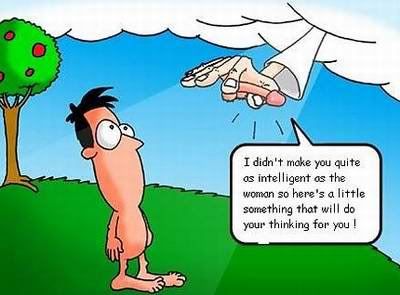
Men are reckless and stupid--they default to their "lower" brain more often than not. At least, that's what this image would have you believe. In this creationist rendition of intellectual inequality, men are painted as savage--hence the nudity and primal nature of the cartoon (yes, I understand Adam and Eve wouldn't have clothes, but the setting and time frame are rather deliberate).

The first line sums it up--then it's expanded on beneath. The advertisement, while extremely dated, represents a facet of misogyny that views women as feeble, physically incapable, or even a detriment to men as a population. The woman is faceless and anonymous, as she attempts to pull herself up with the help of the careless yet confident men. Undoubtedly, the advertisers have taken many different steps in establishing her as symbolic of all women, and establishing women, by a general rule of thumb, as "beneath men." Such an ad seems to claim that men are required to be strong, athletic, outdoorsy, and assertive, while women exist to please the man when he returns from his excursions, hence the line, "Indoors, women are useful--even pleasant."

Evidently, these are the two easiest and most effective ways of being a "good wife." If this doesn't force an idea of patriarchy and a woman's role in it down your throat, then I'm not sure what does. There's no insight I have on such an image--it's worth a thousand on its own... or maybe just the two--sex and sandwich. All this says is that women need to provide for men in the home, and satisfy their every whim. Complete that with an overtly sexual picture of a blond bent over, and you've got a tornado of matriarchy headed your way.
The roles of men and women are concepts that biologists and historians attempt to definitively outline, but the dynamic of every relationship and the independence and strengths of each individual make it impossible to do so. From what the images depict, and what T.V. shows such as I Love Lucy and Leave it to Beaver say, dated though they are, women are "supposed" to stay home, cook, clean, and please their husbands sexually without a fuss or reluctance. Men, on the other hand, are "supposed" to be strong, command authority, provide financial stability, and guide women. Obviously social consciousness has evolved a great deal since the days of Lucille Ball, but there are still many competing schools of thought. Feminism as a school doesn't believe that men are stupid, but there is certainly some fervent opposition to patriarchy in the form of backlashing (women who claim men are stupid and need women to keep them from doing dangerous or reckless things). Modern feminism seeks only equality, and to draw attention to the double standards of gender stereotypes--the same aim of I Want a Wife.
Thursday, October 10, 2013
Now Who Would Dwell In Hell?
Hell in the physical does not weigh on me. I view the Bible through a critical lens. I see the merit in many of the teachings--family values and an appreciation for the wise--but the aspect of fear as a motivation to help others, and the belief that helping others is somehow more virtuous than helping ourselves, these are not teachings I adhere to or respect in the slightest. I'm not one of the atheists who approaches you, telling you you're stupid and misguided for believing in God, but I'm not one to remain silent while others thrust their beliefs in my face. I have a difficult time believing in the afterlife and in an almighty power that controls everything and everyone by a strict moral code. Perfection is abstract, and it seems impossible to me to have a figurative God without flaws. Perfection is a personal standard, because with all of the conflicting beliefs and opinions that people can possibly have, how would God possibly rate one value over another? In any case, it's impossible to deny the merits of religion. My great aunt, at one point in her life, faced drug addiction and troublesome behavior, but turned to God as a vessel of strength, and she found the strength inside of herself to overcome it. We welcomed her back into our lives and she was nothing but the most kind-hearted, altruistic and content woman I had met. Later, she faced a terminal brain cancer--this was a few years ago--and rather than fear death she simply had the most beautiful glimmer in her eyes. She was ready to go, because she had achieved personal satisfaction through religion. Religion may not be for me, but for plenty of individuals, they use it to gain strength and hope in a lost place. That aspect is often overshadowed in my mind by the hate and trivial destruction incurred by religious zealousness or differences. I'm content to allow a mutual respect and indifference--that is, if you want to worship Bielzebub and drink your own blood, that's your M.O. If I don't want to, I shouldn't have to either. The same goes for lifestyle choices in general, and that's where topics such as homosexuality and abortion enter the picture of religion. Churches should not be spreading hate and contempt for people based on choices that don't influence them, coughWESTBOROcough... For those of you who weren't aware of the Westboro Baptist Church's dealings, you are likely shocked and appalled. The hate that they spout has created, truly, a miniature hell on earth for the families and loved ones of many homosexual soldiers, and homosexuals themselves. Hell can be viewed through many different lenses. Whereas one might die of fear should they be slowly submerged into a fish-tank filled with sharks, others simply chuckle--until you mention their deep-seeded abandonment issues. Everyone has different quirks and buttons to be pushed, but it's important to me to remember that no matter what "Hell on Earth" one might concoct mentally, there's always a way to make it worse. A rainy day could quickly turn into a rainy week, and a brutal stabbing could turn into something unmentionable. While we can always, in the dark corners of our conscious, picture a worse scenario, there's simply no purpose. To be asked to describe the worst possible feeling or situation to place myself in is not only impossible, but pointless as well. I choose to not dwell on my insecurities or the ways I could be tortured. I'm not an optimist, but I am a realist, and a realist doesn't waste much time in the hypothetical.
For those of you reading simply to hear about a fear or an insecurity or anything else of that nature--those of you who wish to dig up dirt--I suppose being an only child would be pretty awful. If something were to happen to my brothers, I would be devastated, naturally, but the loneliness resulting from being an only child would be something I couldn't handle. I am mostly introverted, it might surprise most people to read, because I don't display that quality during class at all, but in reality, I'm fairly antisocial.
For those of you reading simply to hear about a fear or an insecurity or anything else of that nature--those of you who wish to dig up dirt--I suppose being an only child would be pretty awful. If something were to happen to my brothers, I would be devastated, naturally, but the loneliness resulting from being an only child would be something I couldn't handle. I am mostly introverted, it might surprise most people to read, because I don't display that quality during class at all, but in reality, I'm fairly antisocial.
Friday, October 4, 2013
Why Now?
Scientific American has tackled a subject near and dear to my heart--empathy.
Allegedly, empathy is quickly vanishing from society. That little voice of guilt, pity, or concern you feel towards others--the understanding of their emotions. In an earlier post I referenced Ayn Rand and Objectivism, which goes hand-in-hand with this article, however, it's difficult to believe that such a philosophy suddenly implanted itself in vast numbers of people. No, my guess is this has more to do with the changing nature of the socioeconomic conflict and the growing gap between the wealthy and the impoverished. A common misconception is that in modern American society, the "rich," or the top 1% of wealth holders. In fact, since 1983, the top 1% has only gained 1.6% of national net worth, while the 19% below that has gained 6%. In reality, the poor appear to be getting poorer, while that lost wealth diffuses throughout the upper ranks fairly evenly. The loss of wealth in the poor, then, has caused even further contempt from he upper classes. Children at institutes of learning where these types of studies are conducted, such as San Diego State University, tend to be of more advantaged homes, and due to the American culture that instills the sentiment that if people are of a lower socioeconomic position, then it is a result of their own doing, or rather, inability to do enough to prevent such a status. Thus, these surveyed students have faced waning empathy for the lower rungs of the economic ladder.
This theme is not unique to modern America, however. The study claims that empathy has declined only over the past 30 years, and that earlier generations can not be accurately tested because “you can’t randomly assign people to a generation.” I predict, however, it has been declining since the 1950s, a period during which affluence was widespread and the distinctions between socioeconomic rankings were more blurred--the era of the Brady Bunch and the nuclear family, when vacuum advertising was a lucrative career. During the Great Depression, however, the divisions between social classes were even more clearly defined, and the working class was hit with tremendous adversity. In the face of this adversity, those who continued to live in relative comfort appeared to hold only the occasional shred of empathy, as seen in John Steinbeck's The Grapes of Wrath.
 The current recession, while dwarfed in comparison, may have inspired a similar effect on the same dwarfed scale.
Allegedly, empathy is quickly vanishing from society. That little voice of guilt, pity, or concern you feel towards others--the understanding of their emotions. In an earlier post I referenced Ayn Rand and Objectivism, which goes hand-in-hand with this article, however, it's difficult to believe that such a philosophy suddenly implanted itself in vast numbers of people. No, my guess is this has more to do with the changing nature of the socioeconomic conflict and the growing gap between the wealthy and the impoverished. A common misconception is that in modern American society, the "rich," or the top 1% of wealth holders. In fact, since 1983, the top 1% has only gained 1.6% of national net worth, while the 19% below that has gained 6%. In reality, the poor appear to be getting poorer, while that lost wealth diffuses throughout the upper ranks fairly evenly. The loss of wealth in the poor, then, has caused even further contempt from he upper classes. Children at institutes of learning where these types of studies are conducted, such as San Diego State University, tend to be of more advantaged homes, and due to the American culture that instills the sentiment that if people are of a lower socioeconomic position, then it is a result of their own doing, or rather, inability to do enough to prevent such a status. Thus, these surveyed students have faced waning empathy for the lower rungs of the economic ladder.
This theme is not unique to modern America, however. The study claims that empathy has declined only over the past 30 years, and that earlier generations can not be accurately tested because “you can’t randomly assign people to a generation.” I predict, however, it has been declining since the 1950s, a period during which affluence was widespread and the distinctions between socioeconomic rankings were more blurred--the era of the Brady Bunch and the nuclear family, when vacuum advertising was a lucrative career. During the Great Depression, however, the divisions between social classes were even more clearly defined, and the working class was hit with tremendous adversity. In the face of this adversity, those who continued to live in relative comfort appeared to hold only the occasional shred of empathy, as seen in John Steinbeck's The Grapes of Wrath.
Tuesday, October 1, 2013
Eh... Not Feeling It
A delightful concept to entertain--compassion. I won't doubt it gives nearly everyone a "warm fuzzy feeling in their tummies," but those who know me fairly well would know I object to Ascher's portrayal of the business men on the subway as heartless and of the shopkeepers as cruel when they shun/shoo the homeless beggars. This, however, much to any reader's delight, is not a rant that references Ayn Rand a few too many times. In a scholastic scenario such as this, nobody cares, quite frankly, about the ways I disagree with Ascher. I will comment, however, on the careful and successful ways she prefaces her thesis, developing her ideas with examples before introducing the true meaning of the story. The businessmen averting their eyes may go unnoticed initially, and the mayor's policy may not seem to be one of such magnitude, but Ascher gives plenty of wake-up slaps in the penultimate paragraph of this work. It is at this point that the reader fully addresses the underlying motivations of these hypothetical characters--these rat-racers and selectively oblivious commoners. One by one these realizations are processed to their full extent, and most readers are left feeling guilty for the ways they, too, have brushed the less-fortunate under the rug or into the gutter. I don't necessarily believe Ascher intends for everyone to begin handing out money to beggars left and right, but she certainly believes in not ignoring the homeless, especially those who have suffered unavoidable tragedy that strikes them into such a state.
Manhattan is a highly impersonal city. With a population exceeding 1.5 million people and a culture heavily rooted in economic pursuit and advancing up the socioeconomic ladder, it's no wonder people feel uncomfortable around the numerous homeless inhabitants.
Manhattan is a highly impersonal city. With a population exceeding 1.5 million people and a culture heavily rooted in economic pursuit and advancing up the socioeconomic ladder, it's no wonder people feel uncomfortable around the numerous homeless inhabitants.
Regarding the illiterate, I'm not sure how to react. I understand I'm supposed to feel the aforementioned compassion that Ascher advocates for, but I don't for a moment. Furthermore, I have a difficult time believing that 23% of Americans can't read at a basic, functioning level. Well, let me rephrase that--I think the study was conducted in a pointed manner, surveying many non-English-speaking people, citizens or not. That statistic is alarmingly high to me, to a degree that I don't buy into. I could easily be wrong, and if that's the case, shame on me for growing up in Napa and not being exposed to this phenomenon. Still, if that is the case, I don't feel tremendously sorry for illiterate people. I imagine it's a difficult life to lead, but not a difficult problem to solve. Even pattern recognition can allow someone to lead a content, granted routine, but functioning nonetheless, lifestyle. The moments when my heart-strings were supposed to be plucked and tugged only made me think they might be a bit out of tune.
Subscribe to:
Posts (Atom)