NSA and CIA operatives have determined that online role-playing games are opportune platforms on which to conduct terrorist acts or plots. Intelligence agencies have determined with some revelation that online games are becoming more and more prominent, and due to the anonymous nature of such games, and the ways that violence already pervade in them and their culture, video games are ideal for creating terrorist plots. With agents in these online worlds searching for seeds of terrorism or domestic/international threats, (or perhaps just getting their Death Knights to level 90) can we maintain our sense of privacy? Internet culture with respect to gaming often features brutal and violent personalities, for the veil of the computer screen and miles of distance make it easy to antagonize people--you likely won't feel any repercussions. Still, there are some who play to entertain themselves or meet other like-minded individuals. While many speak on the internet without carefully considering their words, and likely don't care how they offend others, they may find the federal government knocking at their doors. What may be intended as a tasteless joke in a competitive gaming scenario may be misinterpreted as a threat to national security.
While the government probably will not misinterpret "im gonna kill u" said by sk8rboi420 to be a glimpse into the psyche of a rampant murderer, the frequency at which violence is discussed in video games today makes it nearly impossible to distinguish what is real and what is a waste of time. Are NSA agents looking to lounge around and play World of Warcraft while collecting their paychecks? Or are there really Dwarven Engineers who may be engineering plots against the government? Regardless of whether or not the national government uncovers terrorism in the World of Warcraft, they have drawn some ground-breaking conclusions such as "players under age 18 often used all capital letters both in chat messages and in their avatar names."
Snowden attacks the NSA’s actions as offensive and shocking. In a letter to a German magazine, Snowden vividly describes how objections to government surveillance, which prompted many other national governments to conduct their own investigations.
Washington Post puts the magnitude of the surveillance into perspective by claiming that the NSA gains billions of phone records every day with information on the whereabouts of phones and mobile devices. NSA agents attempt to hide the sheer number of documents collected, as well as other figures.
Who wants to be a millionaire? I'd think nearly everyone, save Buddhists, minimalists, and billionaires. The question is, what price are we willing to pay to get there? Some get caught up in the rat race, some steal and ransack, but most never quite make it to that 6th zero. Charles Ingram was desperate as any to make a bit of money, and when he was called up as a contestant on Who Wants to be a Millionaire? he saw his opportunity. Charles Ingram is by no means incompetent. He's clearly experienced in playing the system, as he develops a system with one Tecwen Whittock, another contestant, to cheat on the show and win the million dollars. He's quickly found out, however, as his system is almost comical to behold.
Here's the first part right at your fingertips. Should you decide you're interested, the rest are linked below.
Still, both Tecwen Whittock and Charles Ingram remind us of a societal flaw that seems to pervade more and more with time. Cheaters seem to prosper. In their case, they were discovered, but in countless insurance fraud instances across the nation every year, people are able to get away with murder, nobody the wiser (in fact, over 30% of murders in the U.S. went unsolved in 2012). Charles Ingram didn't seem to be heard from much afterwards, but did receive some sort of comeuppance referenced at the end of the documentary. Still, justice didn't seem to be the focus of this documentary. It only seemed to further the point that, if done correctly, cheating can be highly beneficial. Others may learn from his mistakes and, as time goes on, there's no telling how cheating might involve, for just as the technology to prevent it advances, the same advancements can be used to break it.
Do cheaters receive more than just a slap on the wrist? More often than not, yes. But they must be caught first, and in that condition lies a great failure of our system--we either ignore cheating when it occurs right before our eyes, or are unable to recognize it before it escalates.
There's nothing more frustrating than someone arguing irrefutably incorrect information. Strike that, there's nothing more frustrating than someone arguing irrefutably incorrect information without realizing it's incorrect. That's the case for me, at least. With the possible exception of being condescended, it's my number one pet peeve, and it happened at Chamber Retreat. Each section was required to present a game to play--a way to unwind after hours of singing. One such game was the classic outdoors sensation known as camouflage. For those of you who aren't familiar, the rules can be found here:
The purpose of camouflage is simple--be camouflaged. That entails being able to see someone without them seeing you. So when the game is explained where it's very easy to sit out of sight and have a distinct advantage over the person in the center, it becomes something entirely different--the infamous Waiting Game (hardly a game if you ask me.) Now upon explanation of "camouflage," to clarify, I attempted to suggest the simple correction to the game that would transform it back into what it was intended to be. We had it set up to where, if you read the rules, rather than hold up a finger to ensure vision was maintained throughout the process of calling people out, the central scouter simply shouted out colors. This completely eliminates the purpose of the game, and when Sheryl Warfield, bless her heart because she can't stand the same things I can't, and I opened our mouths, we were met with exasperated sighs and demonization.
Boom. Instant pariahs.
Granted, the presenter may have felt disrespected, because as he was taught to play the game, it made sense to him, but it was simply incorrect. Looking around, I made eye contact with plenty of people whom I knew had experience playing the game correctly, and they confirmed that I wasn't crazy, but they simply kept their mouths shut. I thought them wiser than I. They foresaw the inevitable consequence of everyone's disdain and scorn. I was impetuous, and for whatever reason, I felt as though I was some sort of crusader against the injustice of a game. Well, Sir Jeffrey the Impetuous, that was a dumb way to look at it. I wasn't "saving" anything, and rather than attempt to enjoy the Waiting Game, I let the flaws burden on me and even got into a verbal fight with the presenter, a good friend of mine. Sure, we're fine now because it was too trivial to get in the way of a good friendship, but there was simply no purpose.
So why do people keep their mouths shut? Why don't people complain when the train reaches 85 degrees or they don't like the music in Abercrombie and Fitch? Because it's just. not. worth it. It isn't worth the disapproval and the dirty looks. It isn't worth starting an argument over something so trivial, and most of all, whether people agree with you or not, you're likely not going to receive much support. We are condemned to silence, and in that silence, we build character.
Regarding trust, we all perceive it differently. There are the gullible ones, who tend to be optimists, the cynical ones, usually pessimists, and everything in between. We all have varying levels of trust for those around us, however everyone eventually learns that there is no common denominator to play to--the extremes are all we can prepare for. We immunize ourselves with mistrust, such that the neurologically impaired or the simply destructive people in society who thrive on anarchy don't have more opportunities than they need to victimize us. Furthermore, in warding off the perils of day-to-day life, we gain a sense of security, but lose the sense of community so many strive to reclaim. What we fail to recognize is that the issue stems from an inability to trust, or that perhaps this inability to trust is not necessarily a failure of society. There are small victories and great pitfalls of our mistrusting culture.
Let us examine locks on our doors. Indeed, they serve a purpose, as most of us don't want a burglar, murderer, or worse wandering into our midst while relaxing and watching Grey's Anatomy. We use locks to feel safe and protected, so that we don't need to have a vigilant watch at all times. Then, why do we need locks on our doors inside the house? Some like to protect their privacy when we change or yada yada,
but to a certain extent, what is the purpose of the indoor lock? It isn't a mistrust of our family members. It's partially a protective measure--not physical but privacy-based. This boils down to social norms. To not have locks on your doors is to be a heathen, a crazy person. To not have locks on your front doors is unthinkable.
Social norms dictate much of what we do, and it isn't all necessarily rational, as we observed in the essays regarding obligatory small-talk and the ways we communicate. Trust is one of these institutions. Schools are required to send home permission slips for field trips, or for watching rated PG movies in elementary school. Most classes, however, scoff at the notion that a parent is going to morally object to a trip to Connoly Ranch or a viewing of Shrek 2. Obviously, school systems are preparing for every contingency--those instances when there is a parent who takes up a complaint and decides to sue the district for all it's worth--but when surveying the class to get an estimate on how many of their parents would be O.K. with Shrek, we ignore their responses and send home permission slips regardless. The word of a child can never be trusted.
The government is responsible for 9/11. Actually, aliens are. Or wait, just Obama. It was his master plan all along, and he's a reptilian space creature bent on the destruction of the human race. No. Just, no. Americans, especially, romanticize mystery and intrigue. That's why tabloids are so popular, and why scandals take down political figures almost daily it seems. Still, conspiracies pervade in our culture, and the most critical piece of them--mistrust for the government. We aren't capable of placing our faith in those protecting us, possibly for good reason, as they constantly lie, (a social norm for politicians) but to an extent that surpasses absurdity. And we satirize it, don't we? We mock the conspiracy theorists, though they're more numerous than you'd believe. We don't trust them, they don't trust us, or science always. Is this to protect ourselves? Maybe against appearing foolish, but not from any sort of real danger. We mock them and don't listen to their warnings because A) they're preposterous mostly, and B) it's commonplace not to.
Insider trading--colluding with sources who hold crucial information about coming trends in the stock market or in sound investments in order to reap massive reward with less risk--has been the bane of many public figures. Hedge fund managers from SAC in 2013 and Rajat Gupta have felt the effects of getting caught with their pants around their ankles. More notably, Hillary Rodham Clinton was accused of tangling with the same legal grey area. With the help of James Blair, a Tyson Foods Company lawyer, she was able to "[net] $100,000 through trading." While this doesn't entail much blatant lying, this is considered dishonest by most everyone informed enough to understand the complexity of such dealings. This is a very unique brand of lie--one that Ericsson didn't seem to touch on. This is collusion and distortion. Hillary Clinton hid behind a curtain of illegality and likely delusion, one that Ericsson was able to aptly explain. While it's generally accepted that Clinton dealt with insider trading, she received no more than a slap on the wrist, as official charges were never brought on, demonstrating the ease of which lies are committed when backed by cold hard cash. Clinton may have victimized the stock market or competitors, but they remained faceless, whereas Bernie Madoff had a profound impact on many American lives, thus, he was made into a pariah and a criminal (I'm not saying he wasn't a criminal by any means) on a grander scale. To return to the matter at hand, however, it appears that lying, while it is a global occurrence that may forever be unavoidable, yields far different results depending on the nature of the lie and the perpetrator's status. Hillary Clinton is a beloved political figure in many households of the United States, (and a not-so-beloved figure in others) so naturally, she had a support group behind her, defending her actions. Clinton supporters seemed to deny the accusations--guilty of lies themselves. Denial, delusion--whatever you label it as, it's a rejection of the truth. The same way conspiracy theorists formulate ridiculous notions that the government caused 9/11, Obama is a space reptile using mind control on the American people, or that the lovable Disney classic Aladdin is set in a post-apocalyptic future, many Americans were content to believe Clinton never committed insider trading. Due to Clinton's already strong reputation among many Americans, it appears it was easier for her to conceal and justify her actions and deflect accusations that appeared to be true.
The Playbook (How I Met Your Mother reference--written by Barney Stinson)
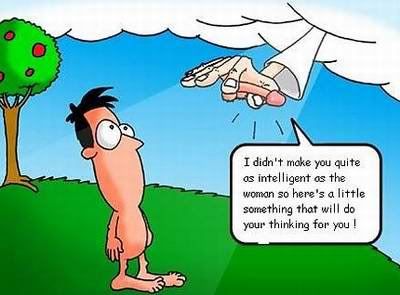
Men are reckless and stupid--they default to their "lower" brain more often than not. At least, that's what this image would have you believe. In this creationist rendition of intellectual inequality, men are painted as savage--hence the nudity and primal nature of the cartoon (yes, I understand Adam and Eve wouldn't have clothes, but the setting and time frame are rather deliberate).
The first line sums it up--then it's expanded on beneath. The advertisement, while extremely dated, represents a facet of misogyny that views women as feeble, physically incapable, or even a detriment to men as a population. The woman is faceless and anonymous, as she attempts to pull herself up with the help of the careless yet confident men. Undoubtedly, the advertisers have taken many different steps in establishing her as symbolic of all women, and establishing women, by a general rule of thumb, as "beneath men." Such an ad seems to claim that men are required to be strong, athletic, outdoorsy, and assertive, while women exist to please the man when he returns from his excursions, hence the line, "Indoors, women are useful--even pleasant."
Evidently, these are the two easiest and most effective ways of being a "good wife." If this doesn't force an idea of patriarchy and a woman's role in it down your throat, then I'm not sure what does. There's no insight I have on such an image--it's worth a thousand on its own... or maybe just the two--sex and sandwich. All this says is that women need to provide for men in the home, and satisfy their every whim. Complete that with an overtly sexual picture of a blond bent over, and you've got a tornado of matriarchy headed your way.
The roles of men and women are concepts that biologists and historians attempt to definitively outline, but the dynamic of every relationship and the independence and strengths of each individual make it impossible to do so. From what the images depict, and what T.V. shows such as I Love Lucy and Leave it to Beaver say, dated though they are, women are "supposed" to stay home, cook, clean, and please their husbands sexually without a fuss or reluctance. Men, on the other hand, are "supposed" to be strong, command authority, provide financial stability, and guide women. Obviously social consciousness has evolved a great deal since the days of Lucille Ball, but there are still many competing schools of thought. Feminism as a school doesn't believe that men are stupid, but there is certainly some fervent opposition to patriarchy in the form of backlashing (women who claim men are stupid and need women to keep them from doing dangerous or reckless things). Modern feminism seeks only equality, and to draw attention to the double standards of gender stereotypes--the same aim of I Want a Wife.
Hell in the physical does not weigh on me. I view the Bible through a critical lens. I see the merit in many of the teachings--family values and an appreciation for the wise--but the aspect of fear as a motivation to help others, and the belief that helping others is somehow more virtuous than helping ourselves, these are not teachings I adhere to or respect in the slightest. I'm not one of the atheists who approaches you, telling you you're stupid and misguided for believing in God, but I'm not one to remain silent while others thrust their beliefs in my face. I have a difficult time believing in the afterlife and in an almighty power that controls everything and everyone by a strict moral code. Perfection is abstract, and it seems impossible to me to have a figurative God without flaws. Perfection is a personal standard, because with all of the conflicting beliefs and opinions that people can possibly have, how would God possibly rate one value over another? In any case, it's impossible to deny the merits of religion. My great aunt, at one point in her life, faced drug addiction and troublesome behavior, but turned to God as a vessel of strength, and she found the strength inside of herself to overcome it. We welcomed her back into our lives and she was nothing but the most kind-hearted, altruistic and content woman I had met. Later, she faced a terminal brain cancer--this was a few years ago--and rather than fear death she simply had the most beautiful glimmer in her eyes. She was ready to go, because she had achieved personal satisfaction through religion. Religion may not be for me, but for plenty of individuals, they use it to gain strength and hope in a lost place. That aspect is often overshadowed in my mind by the hate and trivial destruction incurred by religious zealousness or differences. I'm content to allow a mutual respect and indifference--that is, if you want to worship Bielzebub and drink your own blood, that's your M.O. If I don't want to, I shouldn't have to either. The same goes for lifestyle choices in general, and that's where topics such as homosexuality and abortion enter the picture of religion. Churches should not be spreading hate and contempt for people based on choices that don't influence them, coughWESTBOROcough... For those of you who weren't aware of the Westboro Baptist Church's dealings, you are likely shocked and appalled. The hate that they spout has created, truly, a miniature hell on earth for the families and loved ones of many homosexual soldiers, and homosexuals themselves. Hell can be viewed through many different lenses. Whereas one might die of fear should they be slowly submerged into a fish-tank filled with sharks, others simply chuckle--until you mention their deep-seeded abandonment issues. Everyone has different quirks and buttons to be pushed, but it's important to me to remember that no matter what "Hell on Earth" one might concoct mentally, there's always a way to make it worse. A rainy day could quickly turn into a rainy week, and a brutal stabbing could turn into something unmentionable. While we can always, in the dark corners of our conscious, picture a worse scenario, there's simply no purpose. To be asked to describe the worst possible feeling or situation to place myself in is not only impossible, but pointless as well. I choose to not dwell on my insecurities or the ways I could be tortured. I'm not an optimist, but I am a realist, and a realist doesn't waste much time in the hypothetical.
For those of you reading simply to hear about a fear or an insecurity or anything else of that nature--those of you who wish to dig up dirt--I suppose being an only child would be pretty awful. If something were to happen to my brothers, I would be devastated, naturally, but the loneliness resulting from being an only child would be something I couldn't handle. I am mostly introverted, it might surprise most people to read, because I don't display that quality during class at all, but in reality, I'm fairly antisocial.
Allegedly, empathy is quickly vanishing from society. That little voice of guilt, pity, or concern you feel towards others--the understanding of their emotions. In an earlier post I referenced Ayn Rand and Objectivism, which goes hand-in-hand with this article, however, it's difficult to believe that such a philosophy suddenly implanted itself in vast numbers of people. No, my guess is this has more to do with the changing nature of the socioeconomic conflict and the growing gap between the wealthy and the impoverished. A common misconception is that in modern American society, the "rich," or the top 1% of wealth holders. In fact, since 1983, the top 1% has only gained 1.6% of national net worth, while the 19% below that has gained 6%. In reality, the poor appear to be getting poorer, while that lost wealth diffuses throughout the upper ranks fairly evenly. The loss of wealth in the poor, then, has caused even further contempt from he upper classes. Children at institutes of learning where these types of studies are conducted, such as San Diego State University, tend to be of more advantaged homes, and due to the American culture that instills the sentiment that if people are of a lower socioeconomic position, then it is a result of their own doing, or rather, inability to do enough to prevent such a status. Thus, these surveyed students have faced waning empathy for the lower rungs of the economic ladder.
This theme is not unique to modern America, however. The study claims that empathy has declined only over the past 30 years, and that earlier generations can not be accurately tested because“you can’t randomly assign people to a generation.” I predict, however, it has been declining since the 1950s, a period during which affluence was widespread and the distinctions between socioeconomic rankings were more blurred--the era of the Brady Bunch and the nuclear family, when vacuum advertising was a lucrative career. During the Great Depression, however, the divisions between social classes were even more clearly defined, and the working class was hit with tremendous adversity. In the face of this adversity, those who continued to live in relative comfort appeared to hold only the occasional shred of empathy, as seen in John Steinbeck's The Grapes of Wrath.
A delightful concept to entertain--compassion. I won't doubt it gives nearly everyone a "warm fuzzy feeling in their tummies," but those who know me fairly well would know I object to Ascher's portrayal of the business men on the subway as heartless and of the shopkeepers as cruel when they shun/shoo the homeless beggars. This, however, much to any reader's delight, is not a rant that references Ayn Rand a few too many times. In a scholastic scenario such as this, nobody cares, quite frankly, about the ways I disagree with Ascher. I will comment, however, on the careful and successful ways she prefaces her thesis, developing her ideas with examples before introducing the true meaning of the story. The businessmen averting their eyes may go unnoticed initially, and the mayor's policy may not seem to be one of such magnitude, but Ascher gives plenty of wake-up slaps in the penultimate paragraph of this work. It is at this point that the reader fully addresses the underlying motivations of these hypothetical characters--these rat-racers and selectively oblivious commoners. One by one these realizations are processed to their full extent, and most readers are left feeling guilty for the ways they, too, have brushed the less-fortunate under the rug or into the gutter. I don't necessarily believe Ascher intends for everyone to begin handing out money to beggars left and right, but she certainly believes in not ignoring the homeless, especially those who have suffered unavoidable tragedy that strikes them into such a state.
Manhattan is a highly impersonal city. With a population exceeding 1.5 million people and a culture heavily rooted in economic pursuit and advancing up the socioeconomic ladder, it's no wonder people feel uncomfortable around the numerous homeless inhabitants.
Regarding the illiterate, I'm not sure how to react. I understand I'm supposed to feel the aforementioned compassion that Ascher advocates for, but I don't for a moment. Furthermore, I have a difficult time believing that 23% of Americans can't read at a basic, functioning level. Well, let me rephrase that--I think the study was conducted in a pointed manner, surveying many non-English-speaking people, citizens or not. That statistic is alarmingly high to me, to a degree that I don't buy into. I could easily be wrong, and if that's the case, shame on me for growing up in Napa and not being exposed to this phenomenon. Still, if that is the case, I don't feel tremendously sorry for illiterate people. I imagine it's a difficult life to lead, but not a difficult problem to solve. Even pattern recognition can allow someone to lead a content, granted routine, but functioning nonetheless, lifestyle. The moments when my heart-strings were supposed to be plucked and tugged only made me think they might be a bit out of tune.
The pressures of homecoming are sinking in. As we approach the fateful day, everyone is rushing to find outfits, dates, and arrangements for beforehand. I've been with Sheryl for about two years now and our relationship was born out of homecoming, thus, it holds special significance to us.
(AWW LOOKIT HOW CUTE!)
This year her dress is teal and silver--I'm a fan of color, as many are able to tell by my brightly colored shorts. The trouble with teal, however, is it's darn-near impossible to match in tint and hue. The spectrum varies so greatly, and a feminine teal tends more towards green while a masculine teal is more blue. We decided to go shopping after school yesterday, and only after scouring Calvin Klein and Kohl's, the two go-tos for outfit shopping for men in my opinion, did we find a hope of a dress shirt at Nautica. I've been wearing Nautica cologne for about the entire duration I've been with Sheryl, so there's a familiar scent when we walk in and spray the Blue sample on one of the tester cards. At this point, I was reasonably discouraged, and began laughing when the shirt we found--seemingly the only shirt in existence to even closely resemble her dress--was a XXXL. Nice. Never fear, though! They also had one in small... That's what to expect when perusing the clearance rack, I suppose, but everything else in that store is neon polos and funky hats. The fact that this shirt existed at all was a miracle--let alone in Nautica. Across the room, however, Sheryl spotted a large, just as I was slumping back into my discouraged former self. Checking out, the clerk--an extremely kind and smiley man who likely puts it on every day--asked me if I wanted to round my purchase up to the nearest dollar to donate to charity: water, a Nautica initiative. I've never been much for charity, but then, nobody has ever asked me to round my purchase and save myself from the strange decimal that attacks my obsessive side. No, I'm not going to pretend I'm the Messiah, come to save the Earth and its inhabitants because I gave 25 cents to charity, but I'm personally interested in it. From an economic standpoint, it's clever. People are more inclined to donate when it's in small quantities like that, and it's oddly appealing beyond the feel-goodery that charity brings most people. From a humanitarian perspective, I felt fuzzy. No, I didn't bask in glory or whatever it sounds like, but it was strange, the way they got me to donate. Self-sacrifice isn't my thing... on any scale. Still, I didn't mind all that much. That's sort of how I justify much of Objectivism, I suppose. There will always be the people who feel compelled to give to others, and I encourage them to if they feel good doing it, but I don't approve of people giving just for the sake of giving, because they feel as though they owe it to the world. I don't believe in the sense of obligation to care for the fellow man. I do approve of the fuzzies though. Those are mighty keen. Peachy, even.
Kiddies, gather round, because it's everyone's favorite time--save dinner and nap. Yeah, you guessed it--story time.
Now this isn't the "once upon a time" or "a long time ago, in a galaxy far, far away" type of story. This isn't even the type of story where everyone realizes the power of friendship as it conquers the clearly more well-equipped villain--and no, this isn'tSPARTA. None of it rhymes, and there aren't an aggressive number of made-up words blanketing reality. Without further ado, the story:
Poe Newman always caught a lot of flak for his name. Sharing a name with a Teletubby isn't exactly the most desirable undertaking--and it certainly isn't one he chose. Slightly dorky throughout elementary school, (though, let's be honest, who wasn't?) Poe never felt completely accepted by his peers. He excelled in academia, but then, loneliness will expedite learning when you've nothing better to do than focus on the cold, hard facts of education. As he shuffled home from the bus stop one afternoon, his 7-year-old feet bounding him up the stairs to his patio in the upper-middle-class reaches of his quiet town, he heard a voice calling him over to the family mommy-van.
"Poe, honey, put your backpack inside and come to the van." Poe's mother's voice was soothing and rich--when he could no longer handle the stress of subtracting 2-digit numbers, she was always the perfect remedy.
Poe darted as fast as his stubby legs could take him. This outing was unplanned, and the Newman family liked to stick to a rigid schedule. Perhaps that would explain his socially-awkward nature. Still, on this day, his mother held back a smile as they backed out of the driveway and drove into town, past the other schoolchildren walking home with their books in hand and their eyes pointed down.
"I was going to wait to tell you, but I've decided it's time you have a pet. Your father and I are sometimes busy and we figured you might like a dog to keep you company." Poe cringed. The thought of opening up to another being, let alone a stupid, slobbering ball of fur, reliable as it may be, terrified him. Still, there was no escape. He loved his mother too much to even politely let her know that he wasn't interested. Instead, he feigned the most innocent of smiles and awaited the pound.
It was just as he imagined. It was dimly lit--misery pervading. He started to suspect his mother was pulling his leg, and that she would actually take him for ice cream. He started to thank the lord that he only had a leg to pull, and humans had evolved from a tail long ago, because when he observed the volunteers yanking the puppies from their kennels by them, the whimpers and cries were enough to convince him to be content to go without.
"Pick one, Poe. It's up to you. Just remember, you have to take care of it. Maybe something smaller--something that won't shed so much..."
He stood stoic. Judgment day was here. He was being forced to select a creature with which he would share intimate secrets. He couldn't do it--it was too much to ask of a 7-year old who just learned how to tie his own shoes and to whom riding a bike was such a perplexing and difficult request.
Then he saw the cats. Poe didn't know much about much, but he had observed on Saturday-morning cartoons that cats are regal creatures--perhaps not as dependable as dogs, but they require far less attention. He needed an out, and this was it. Cats are smart. They don't need my affection. They certainly don't ask for any favors or hand any out. And they aren't annoying enough to feel compelled to follow you around. They can think for themselves, almost. I'm not about to spend all my time nurturing a dog that doesn't care whether or not I try.
His mom took notice of his silence and offered, "Poe, dear, we can go home if you'd like." Her disappointment was dripping and Poe couldn't ignore it. Instead, he marched down the row of cages, eyeing each one.
Everything he suspected about cats appeared true--quiet, content, airing on the snobbish side. There were grey, mangy ones with hate in their eyes, and plump, white masses turning their scrunched little faces away, as though they were ashamed to be seen in such a setting with such company. They all purred and meowed, voicing their disgust, and Poe certainly would have loved to agree publicly, had he not been stressing to please his mother.
Then there was this one. It was a small, orange striped Munchkin. A tiny little thing, as its breed suggested, but perhaps the runt of the litter. Its eyes held a glimmer of hope--hope dashed with fear. The glimmer spoke volumes of its character. It feared for its life in a place it understood was dangerous, and it feared confrontation. Secretly, it hoped no one would adopt it, because that only meant having to coexist with a human--the creature who rejected it initially. Poe understood its plight. It was lonely, awaiting the judgment day. It was lonely like him. If he had to pick something, and he did, it was at least going to be an animal eh could identify with. This was the one. Poe pointed as a slight grin spread across his face.
They drove home with the new family member in the back seat--stuck in an even smaller cage than before. Quickly the bars were shrinking in on him, too, as he could feel the reality of his situation closing fast. Gone was the isolation. The familiar, comforting sound of clamor enveloping the empty space could never be reclaimed. Strangely enough, the small little ball of fur was panicking as it was thrust into a family, because the darkness of isolation is a life not easily abandoned.
It took some getting used to, but Poe and Dipsy--that's what he named him, partially out of resentment that he was the only one he knew with a Teletubby name, partially because it sounded like an appropriate cat name--eventually warmed up to one another. Poe would come home from school and try and teach Dipsy the rules to lava monster, or that "a lot" is actually 2, distinct words. Everything he felt he couldn't share his excitement about with other children, he shared with Dipsy. Being a kitten, he required a fair bit of attention. Initially this was much to Poe's disdain, but after learning to open up to a genuine creature such as Dipsy, it became second nature to nurture his own little fur-ball. Furthermore, Poe and Dipsy developed their own way of communicating. Poe could ask him if he was hungry by patting his tummy in just the right spot, and Dipsy, more often than not, would open his mouth up wide and begin cackling an alien, grotesque cackle that only a brother could love. They truly were--brothers, that is. In the summer, Dipsy came camping with them, and in the fall, Poe would rake the leaves into piles for him to jump into. Frustrating for anyone else, probably, but having to rake the leaves 8 or 9 times over was only an investment for Poe. It seemed the two were inseparable, and occasionally, Mrs. Newman would walk down the hall late at night and see Poe's bedroom light still on, only to find that they had fallen asleep cuddling with a bedtime story falling slowly out of Poe's relaxed, outstretched hand. Loneliness became the past, and they journeyed on into a life of camaraderie.
The summer before middle school changed Poe. He began to try new foods, take walks outside with Dipsy, feel the tall grass in the fields behind his house. By the time 6th grade had rolled around, he had seen just about every intricacy of his little town and eaten just about everything it had to offer. With a bit of culture and experience, he was able to confidently interact with a few of his peers. He finally had a best friend--besides Dipsy, of course--named Josh. Josh and Poe were a dynamic duo--smart, adventurous, and cunning. Out in the fields behind Poe's house, they would rig traps for rodents and see how many they could catch. Whoever had more by the end of the day won, and the loser bought Slurpees. 7th and 8th grade only brought on more adventures.
The bell rang on the last day of school before winter break. Amid the screaming and cheering and papers floating to the ground while students ran for their parents' cars, Josh and Poe ambled out to the bus stop. They rode the same route every day.
"Hey man, I was wondering if you wanted to come over, seeing as how it isn't a school night and all. Maybe you could sleep over."
Poe froze. He had never had a sleepover with anyone besides Dipsy, but that doesn't count. Josh was really his only human friend, and he had never offered. Poe, certainly, was too nervous to ask. He didn't wish to overstep his boundaries. Yet here he was, practically shaking with a mixture of terror and excitement. Play it cool, he told himself.
"Poe? You okay?"
He snapped back into the present and voiced his willingness.
"Sweet. You can just get off on my stop then and we'll walk to my house. We can find you a toothbrush."
A new chapter had begun.
Poe never knew the joys of spending the night at someone else's house before. He was treated like royalty--Josh's mom practically waited on them as though she was working for tips. They talked, played on the trampoline, and mercilessly slaughtered people in the new Call of Duty. Neither of them was particularly great at the game, so they would laugh every time their head exploded or one of them would freak out as soon as an enemy came on screen. The rare victory was punctuated with an "OHHHHHHHHH!!!" or two. When night time came, and they decided they needed some sleep at last, they stayed up talking about all the cute girls and what high school would be like. Poe had no idea. He was content, though, at last.
High school finally did come, and Poe, while rather bright, was pressured to work hard.
"College won't let just anyone in," his mother would say. He knew. He stressed about it every day, and studying began to consume much more of his time. When he wasn't studying, though, he hung out with Josh and their new friend, another, even quieter boy, named Terry. The three of them went to lunch every day and shared almost every class with each other. Sleepovers were no longer a rare occurrence. It seemed Poe was away more than he was home, and Dipsy took notice. When Poe would return after 3 or 4 nights at Terry's, Dipsy would be waiting with his sad eyes. Even though he was no longer a kitten, he could whimper and cry all the same. It crushed Poe every time. Still, he would leave.
There was one girl, in Poe's English class his sophomore year, who he would steal glances at. She was the most beautiful, most perfect woman in the whole world, he thought. And he had the utmost respect for her intellect--she was near the top of the class. Amber--with hair exactly as her name suggested. He would never dare approach her, however. When she caught him staring he would immediately avert his eyes. What he didn't realize is, her giggling was of flattery, not of pity or mockery. Terry and Josh took notice--they tried to talk him up to her, but she wanted, more than anything, for him to be assertive. As soon as they told him, he was all bravado. Poe was gone. This was Ram-Poe. Poe Norris. Poe Diesel, even. The Fonz looked like a child compared to this new man. They immediately started dating, and it never ceased. Throughout high school, they became inseparable. When she met Dipsy, she fell in love, and the three of them would occasionally spend time together watching movies on his couch, though they could never remember the plot, curiously enough... Little by little, though, that time shrank away. Soon, especially when Poe got a car--a used limousine, because it was cheap and he could guilt-trip his friends into paying for gasoline when they all rode with him--they stopped including Dipsy altogether. He had no time, working hard in school and taking Amber out every weekend. As a senior in high school, there was simply no room in his schedule for his childhood kitten, even if he was his best friend for life. For life, he told himself. That's what a pet is for--to love you unconditionally.
Poe walked in the door late one evening--he had just seen a scary movie with Amber and drove her home around midnight. The house was still, eerie. Only the sounds of the heater could be heard as it combated the frigid harshness of winter. He removed his scarf and hung it up on the rack. Something was different though. The coat rack had always been low--within Dipsy's reach, and when Poe came home, Dipsy was always there to scratch his wool clothes. He went through about a scarf every few days in the winter. Mackelmore became his Messiah.
This time, however, there was no deathly scraping noise. There were no satisfied meows to assuage that noise either. Poe searched around. Dipsy's bed was empty. The couch was desolate. Poe's room was dark and quiet, and the sheets were not ruffled and housing a mischievous ball of fur with a Teletubby's name.
Dipsy was gone.
Poe was a mess. Still, he understood. He knew all too well why Dipsy had left. You see cats are smart. They don't need your affection. They certainly don't ask for any favors or hand any out. And they aren't annoying enough to feel compelled to follow you around. They can think for themselves, almost. They understand that, when people push them aside, they aren't wanted anymore. Their purpose has been taken away, and they, like most creatures, don't appreciate being cast aside. Poe knew how that felt better than anyone. He simply forgot.
Not only that, but they are always
right, and more importantly, you are always wrong—at least, that has been the
trend among the mentalities of the masses in the past generations. So afraid
are we to admit fault or uncertainty that the language of our generation has devolved
to a state of inaccuracy and the grasp on what was reality versus what was opinion,
a difference often indistinguishable, became tenuous without even a remedial
realization that the arrogance that plagues us may not always be reasonably
incurred. Instead, we are an oblivious people, bigoted in our own ways and made
sure of every small thought our minds can create with some quick, measly
justifications. This, on that note, is nothing more than what I can justify it
to be—an attempt, and an essay, as it were. Christy Wampole believes in this
plight on modern culture—the stigma against the uncertain and the belief that there
is a direct correlation between confidence and correctness. She knows the
origin of the essay to be the French root for “to try,” and not, as one might
theorize, “to convince.” While her attempt may be too far in the other
direction, almost implying that writing should be never used persuasively, the
accuracy with which she pegs society is intriguing. Essays are designed,
nowadays, to present a point and convince the reader of some thought or ideal
that the author often holds himself. This “essayism” attacks reason and
introspection—it perpetuates what Wampole describes as “meditative deficiency.”
Then there are the Matt Richtels of
the world. He, seemingly, agrees with Wampole’s assessment of the strictness of
the modern essay, but makes no comment on the issue of expression versus persuasion.
He comments on a different battle—expression versus semantics. As technology
continues to pervade in modern culture, its presence can no longer be denied in
the educative realm. With that given, technology appears to have a degenerative
effect on the language of its users, with autocorrect and vernacular
undermining the classical teachings and corroding the minds of each generation
slightly more than the previous one. Indeed, the necessity to express our
opinions through microblogging and social networking has caused considerable
regression, and both Richtel and Wampole notice such a danger. Richtel, though,
harbors concerns more practical and relevant to the progression of society’s
functionality rather than simply concerns regarding the preservation of a
language and a sociological tendency.
Wampole and Richtel present apt
points regarding the state of the English language and its slow evolution, but
I disagree with a few points in their arsenal. Brilliance being the operative
word in Richtel’s final paragraph, how might the expressive art forms shine
with the mud of conformity seeping in? His concerns regarding a
creativity-deficient language are not unique to the field of writing. The multimedia
world and the music world, particularly, suffer from the same demise, as “sex,
drugs and rock and roll” can now be more appropriately adapted into “sex,drugs, and loud bass.” With multimedia, videos in particular, edging more
towards the absurd, and the glamour of being labeled “crazy” if it lands you a
spot on tosh.0, it seems conformity is a degenerative condition common to many
forms of modern expression. Writing suffers from its difficulty. As multimedia
begins to dominate, and formulaic language becomes the curriculum in schools,
society is left to its blissful regression—to its nut-shots and Ms. America pageants.
We are content to sit idly, singing “la, la, la” with our fingers in our ears, alienating
reason and intelligent cognition.
Once upon a time--yeah there we go. Once upon a time there lived a boy, with wonder in his eyes and a dream beneath his wings. No, he wasn't a Guardian of Ga'hoole. He was Jeff--or Jeffrey--whichever you prefer because the mundane details of his life, and the semantics of how to refer to one another do not weigh on him. "You can call me Sandy/Monique/Dan for all I care," he would say. Once you got to know him, you wouldn't be surprised to find his favorite color is clear, and that he, more than damn near everything in this life, wants to hold a Red Panda. Apart from the trivialities of his character, however, is the paramount concept of reason. Logic is held "as an absolute" and Jeff attributes this crucial piece of his being to Ayn Rand, the author of The Foutainhead and Atlas Shrugged.
A Libertartarian by politics and an Objectivist by nature, Jeff does not dilly-dally in idealism or fiction. While his impetuousness occasionally prevent the devout following of this philosophy, Jeff, when given time or a difficult decision, consults his inner voice and carefully considers the repercussions of his decisions. That may come as a shock, considering he may be one of the loudest and most obnoxious people you'll ever meet in your limited time on this spaceship called Earth.
Above all else, Jeff is about "gettin' hella gains" in whatever he does. Disregarding being immensely lazy, he is driven to succeed and be a powerful and influential member of society at some point--can you say Narcissist?
...because I can't. Words are hard.
Back to the point. Jeffrey/Dan/Molly/Sebastian/Gregory/Yolonda highly regards humor, and often attempts to make people laugh. I never said successfully... But it would be great to throw him some pity here and there--also money and presents.
Jeffrey has two brothers--Derek and Kenny Hanton, who both attend college in the UC system, Berekeley and Davis, respectively. He has no witty catch-phrase to end his posts on, and plans on ending everything mid-